
Relational Agency
Our Foundational Proficiency
Relational agency is our foundational proficiency.
Relational agency allows individuals to remain steady under evaluation, think clearly under pressure, and sustain connection even during disagreement.
At the Creative Humanity Alliance, strengthening relational agency is central to our mission.
Why Relational Agency Matters
Modern life is structured around evaluation.
Grades.
Performance metrics.
Rankings.
Productivity.
Visibility.
These tools are not inherently harmful. They are mechanisms designed to manage complexity at scale.
The challenge arises when structural pressure becomes personal identity.
When evaluation is internalized as worth, leadership becomes reactive. When performance defines identity, connection becomes fragile.
Relational agency protects against that collapse.
It allows individuals to:
In short, relational agency stabilizes identity inside complex systems.
The Structural Model
We understand relational agency as a foundational proficiency supported by two essential literacies.
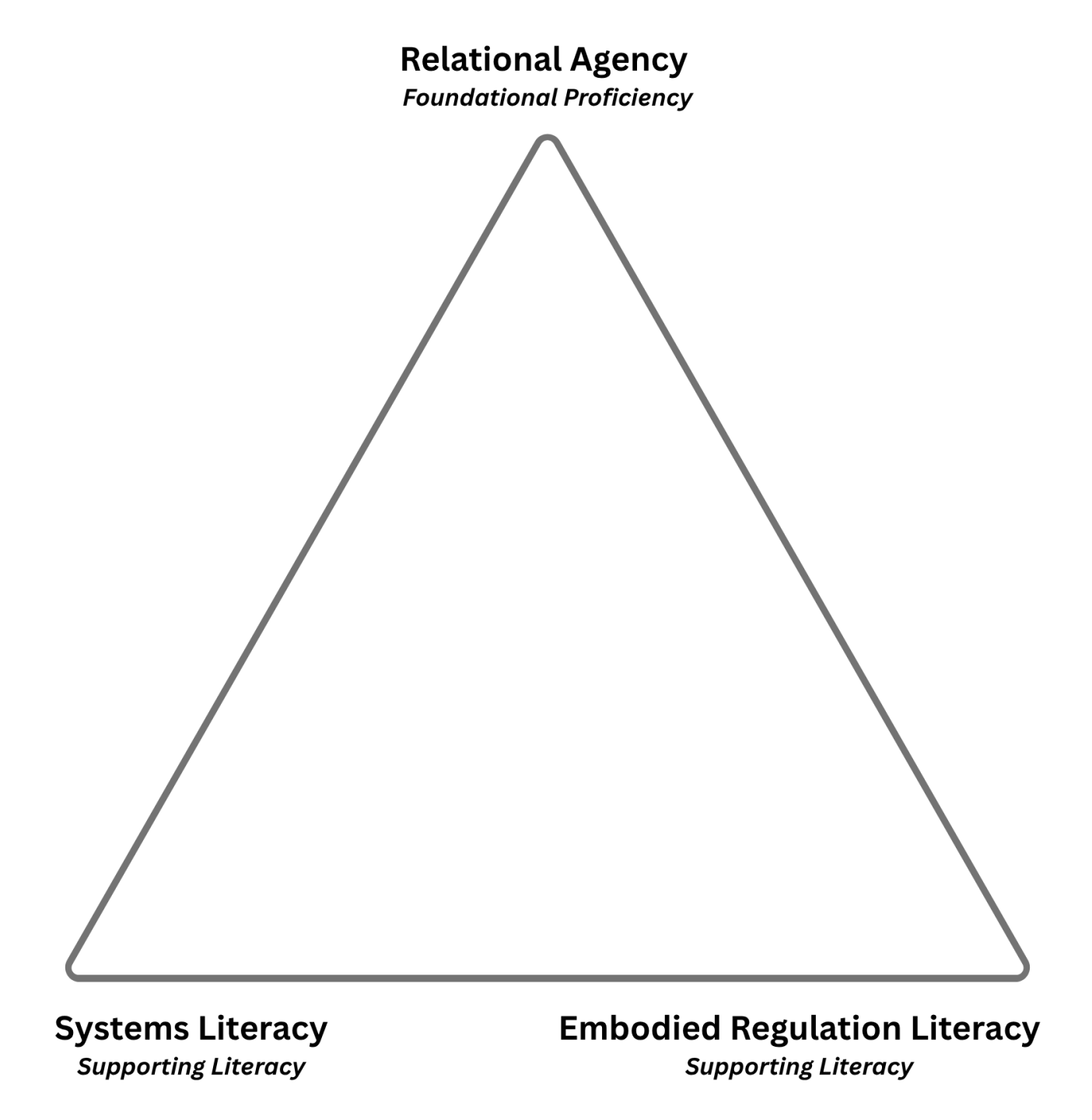
Systems literacy and embodied regulation literacy together stabilize relational agency.
Systems Literacy
Systems literacy is the ability to distinguish structural pressure from personal identity.
Modern institutions rely on metrics — grades, performance evaluations, productivity measures, rankings. These mechanisms compress complexity into measurable outcomes.
Systems literacy allows individuals to recognize these tools as structural devices rather than personal verdicts.
Without systems literacy, pressure becomes personalized.
With systems literacy, individuals can engage demanding environments without internalizing them as definitions of self.
Embodied Regulation Literacy
Embodied regulation literacy is the ability to recognize and stabilize physiological activation under stress.
Evaluation activates the nervous system.
Competition activates the nervous system.
Uncertainty activates the nervous system.
Embodied regulation literacy allows individuals to:
Without embodied regulation literacy, identity becomes fragile under pressure.With it, clarity remains accessible even in high-demand environments
Relational Agency and Leadership Identity
Leadership identity forms under pressure.
The question is not whether it forms — it always does.The question is how.
Without relational agency, leadership identity often becomes performance-dependent. It must be continually proven, defended, or optimized.
With relational agency, leadership identity becomes steadier. It can adapt without fragmenting. It can respond without losing coherence. It can act without disconnecting.
This distinction is especially critical during transitional periods — such as the shift from high school to higher education — when commitments begin to solidify.
Applied Development
Relational agency is not strengthened through theory alone.
It requires structured reflection, embodied practice, and real-world application.
Our programs are designed to cultivate systems literacy and embodied regulation literacy in environments that test identity under pressure.
The Adaptive Leadership Cohort is one developing initiative designed to strengthen relational agency in recent high school graduates at a pivotal developmental stage.
Frequently Asked Questions
Relational agency is the ability to function within systems — such as schools, workplaces, or communities — without losing connection to yourself or others.
It means being able to:
Handle evaluation without internal collapse
Engage disagreement without escalation
Make decisions without confusing pressure with identity
It is a stabilizing leadership proficiency.
No.
Emotional intelligence focuses primarily on emotional awareness and regulation.
Relational agency includes emotional regulation but extends further. It involves structural understanding — the ability to distinguish system demands from personal worth — and to act with clarity inside those systems.
It is both internal and relational.
Leadership identity often forms during high-pressure transitions.
The period between high school and higher education is a pivotal developmental window. Commitments begin to solidify, and evaluation intensifies.
Strengthening relational agency at this stage helps emerging adults enter demanding environments with greater stability and intentionality.
No.
The Creative Humanity Alliance does not provide therapy or clinical intervention.
Our work focuses on developmental leadership proficiency — building structural understanding, relational literacy, and identity stability within real-world systems.
Relational agency develops through:
Systems literacy
Embodied regulation practice
Structured dialogue
Applied leadership engagement
Reflection under real conditions
Our programs are designed to cultivate these capacities intentionally.
Pantry provision downloads since September 2025
Pantry Provisions are the transmissible artifacts of connection and the first layer of Alliance value.
our humanity is the common thread
Restoring Connection Through Creative Awakening
The alliance is a movement of makers, storytellers, musicians, artists, and visionaries reclaiming what the world has forgotten— our inner voice, our shared humanity, and the power of remembering together.
Be an ally.
Allyship takes many forms. A financial gift helps us build and sustain these tools. Sharing this work helps it travel — into conversations, classrooms, studios, and communities we may never reach on our own.
If something here mattered to you, consider passing it along. That simple act is one of the most powerful ways to stand with this work.
Creative Humanity Alliance, Inc. is a nonprofit organization incorporated in the Commonwealth of Massachusetts. We have been granted 501(c)(3) tax-exempt status by the IRS effective date September 12, 2025
Copyright 2026 Creative Humanity Alliance - Privacy Policy